Radicals build kanji. Kanji build words. PakaPaka gives each step a mnemonic made from the step before it, so nothing is new twice. Grammar, reading and reviews are in the same app.
No account needed. Your progress stays on this device.
You do not learn a mnemonic for each item from zero. The picture you learn for a radical comes back in the kanji, and the kanji story comes back in the word.
Each radical is one picture that looks like its shape.



The kanji story uses only the radicals you know.
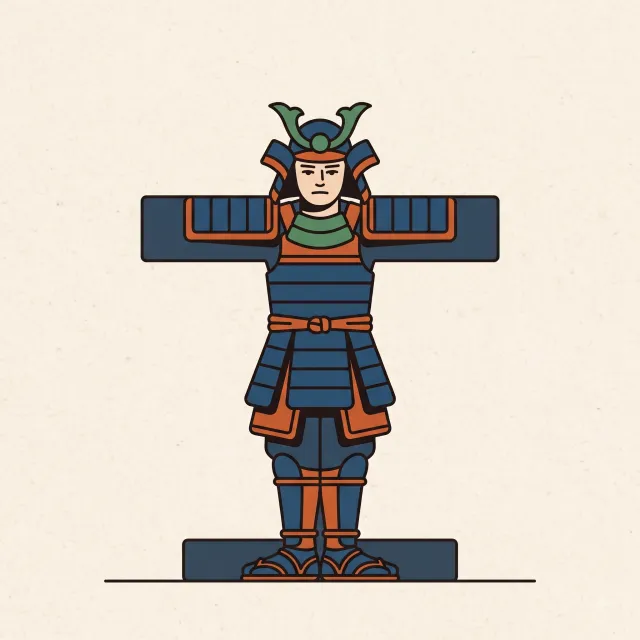
A samurai too proud to be seen throws a cover over his face and takes to the road on his own human legs, where the only work left is to sell.
The proud samurai hides his face under the cover and trudges the road crying 「ばい」, buy, buy, since the only work left to him is to sell (売).
The same samurai comes back to give you the reading.
The sell kanji and the to sell word are exactly the same, so they mean the same thing.
Face hidden under his cover, the proud samurai walks the road with a stuffed kangaroo, calling ooh, Roo, 「うる」, at every gate, since all that is left is to sell (売る) it.

Each grammar point has a full lesson and a story mnemonic. Then it goes into the same review queue as your kanji and words.
Your friend asks if you have ever eaten sushi. Not "do you eat sushi", but "have you ever". Japanese says it with a small noun, こと, after a verb in its past form: "the thing of having eaten exists."
Han the half-and-half chef unbuttons his coat to show half a taco toga, shell crumbs on the hem: proof he has done it before. 日本に行ったことがある。
You wrote 歩く. The English is negative: 歩かない.
No multiple choice. When you make a mistake, the app marks the exact part and tells you why.
Most learners use one app for kanji, one for grammar and a flashcard deck for the rest. Each one has its own cost, and none of them knows what you learned in the others.
One path and one review queue. Free, with no subscription.
Kanji, words and grammar are mixed in one queue. It finds the items you get wrong and shows them first.
Romaji changes to kana while you type. A typo does not count as a miss.
A passage opens when you know about 90% of its words. Furigana hides for the words you know.
An AI partner that uses only the words and grammar you learned. You bring your own key.
No streak on Home. The daily ring can go past 100%. Vacation mode stops the pile-up.
Code under MIT and content under CC BY-SA. 2,000 kanji, 9,749 words and 817 radicals.
An account is optional. The app is complete without one.
Sign in with Google or Apple and your progress follows you between phone and browser. This is not ready yet.
Export your progress to a file at any time and restore it on a different device by hand. No server.
Start in this browser now. No account, no payment.